On Building with Quiet Materials
Before a single wall went up, samples were left outside for a season to see how they would age. Six of the nine were rejected. What follows is what the other three taught us.
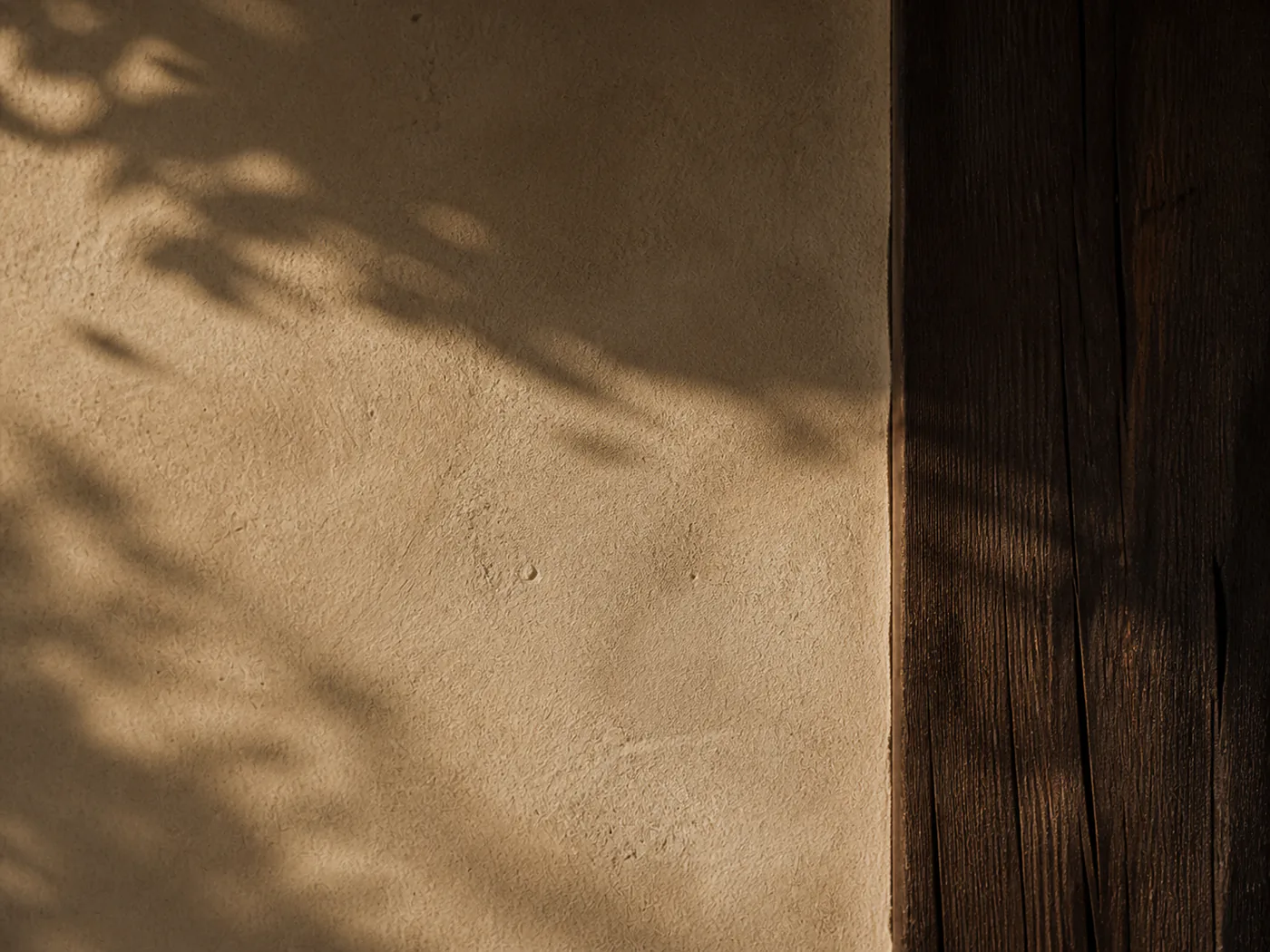
The first decision was not a shape. It was a surface. Before any plan was drawn, samples of clay, lime and local timber were left outdoors on a bench above the site to see how they would age — which ones would grey gracefully, which would darken, which would hold the warmth of afternoon light long after the sun had moved on.
They stayed there for eight months, through the end of one dry season and the whole of a wet one. Nobody protected them. That was the test.
Six of the nine were rejected. Two cracked in the first month of rain, which was informative but not surprising. One went a flat, chalky colour that looked less like age than like a mistake, and that one was the most interesting failure, because on the day it was made it had been everybody's favourite.
Surfaces that are worked by hand
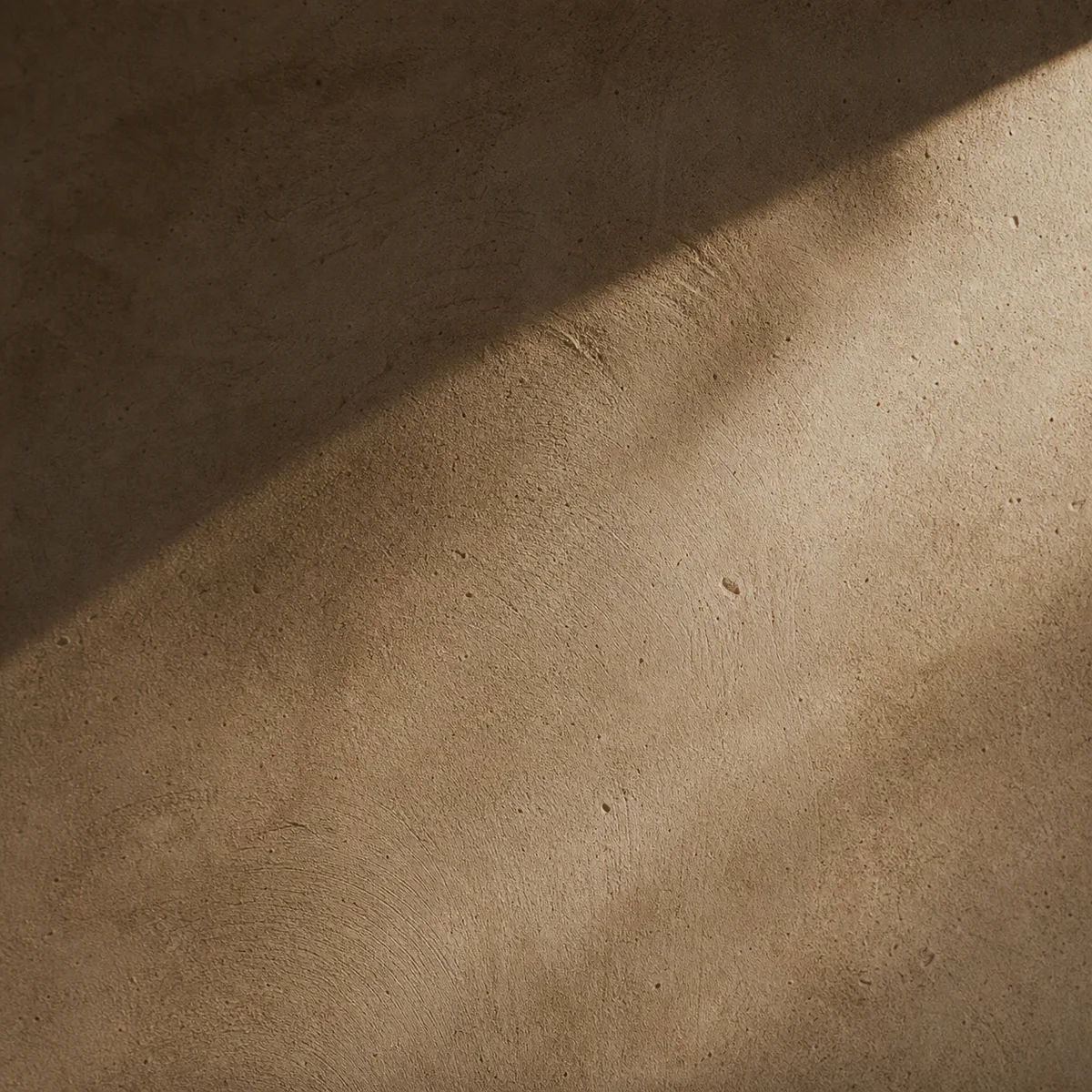
Materials that behave quietly tend to be the ones that are worked by hand. A lime plaster wall is never flat. It carries the trace of the person who floated it, and it catches raking light in a way that changes hour by hour. A machine-perfect surface gives you the same wall at nine in the morning and five in the afternoon. A hand-finished one gives you two different rooms.
You notice this most in the corridor between the two lower rooms, which has no window of its own and takes all its light second-hand from the courtyard. On a flat wall that corridor would be dead space. On this one it changes four or five times a day, and people slow down in it without being able to say why.
A wall you can read the weather on is worth more than a wall that always looks new.
This is not nostalgia. It is a practical observation about how long a building stays interesting to live in. Surfaces that hide their age need constant maintenance to keep the illusion; surfaces that show it need almost none. The maintenance budget for this house is, by design, mostly a ladder and a tin of oil.
Timber, and where hands land
Timber was taken from managed local stands and left largely untreated inside the rooms, oiled only where hands meet it — door pulls, the edge of a desk, the lip of a bath. Those are the places that will darken first, and they are meant to. A house should keep a record of the people who have stayed in it.
The screens along the terrace are the exception. They take the full weight of the afternoon sun and the whole of the wet season, so they are oiled twice a year and will still silver within a decade. That was accepted at the drawing stage rather than fought. A building that argues with its climate loses slowly and expensively.
Nothing is fitted tight. The boards move several millimetres between February and August, and every joint in the house was detailed with that movement assumed rather than resisted. The first year, two doors stopped closing in the wet season and then started again in November. They were not planed. They were left alone, and they have behaved ever since.
What the four materials do
The material palette, in full
- Local timber — structure, screens, floors. Moves with the humidity, which is why nothing is fitted tight.
- Lime plaster — interior walls. Breathes, so the rooms dry out between storms instead of holding the damp.
- Dry-laid stone — courtyard, thresholds, the bath surround. Stays the coolest surface on the property through the hot months.
- Undyed textile — curtains, bedding, cushions. Filters light without colouring it, which matters in rooms where the light is the main event.
What we would do differently
Two things. The stone thresholds should have been a further ten millimetres proud of the floor — water finds the difference in a heavy storm, and mopping a hallway twice a year is a small but avoidable irritation.
And the plaster in the kitchen was a mistake. It is beautiful and it is porous, and a kitchen is not a room that rewards porous. It has been sealed on the two walls behind the work surface, which spoils them slightly, and that compromise is visible if you know to look.
None of this is a style. It is closer to a set of constraints: use what is near, work it by hand where the hand will be felt, and let the light do the decorating. Everything else the building does follows from those three, including the errors.